
English| EUR
Suggested for you
More currencies
Choose a language
The intensity of bioluminescence in Puerto Mosquito depends on three variables: lunar phase, recent rainfall, and water temperature. This page maps the calendar windows when those factors align, the months to avoid, and the hour-by-hour visibility curve once you arrive.
Quick answer
The bioluminescent bay puerto rico best time to go falls during new moon phases between December and April, when dry weather keeps salinity high and moonless skies let the dinoflagellate glow dominate. Tours operate nightly from 18:00 to midnight, but visibility peaks in the two-hour window after twilight when ambient light fades completely. Avoid full moon weeks—direct moonlight washes out the bioluminescence even when organism density is optimal.
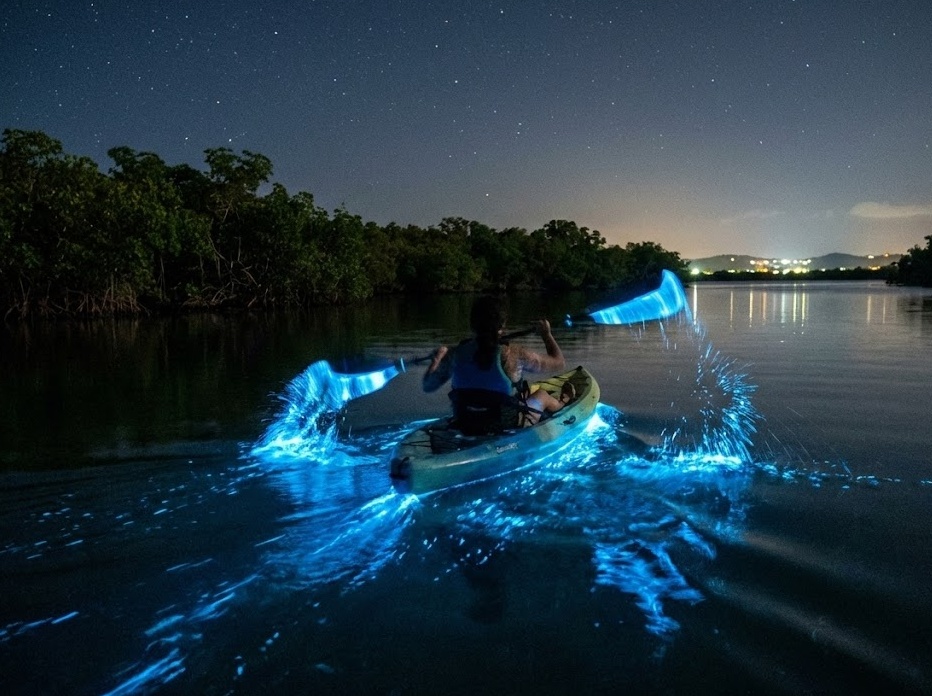
Puerto Mosquito holds the highest concentration of bioluminescent dinoflagellates ever recorded in a single body of water—up to 720,000 organisms per gallon under ideal conditions. That density, however, tells only half the story. The glow you perceive depends less on organism count than on contrast: the darker the surrounding environment, the more vividly the blue-green light registers against your retina. Lunar phase governs that contrast more than any other factor, which is why the bioluminescent bay puerto rico best time to go aligns with the new moon calendar rather than a fixed season. The dry months from December through April offer the most reliable conditions. Rainfall dilutes salinity and temporarily suppresses dinoflagellate activity, so the weeks following heavy storms produce weaker displays. Water temperature also matters—dinoflagellates thrive between 75 and 85 degrees Fahrenheit, a range the bay maintains year-round, but late summer and early fall bring increased risk of tropical weather systems that stir sediment and cloud the water. Tour operators on Vieques track moon phases and weather windows closely, adjusting departure times to capture the darkest skies. Visitors planning a Mosquito Bay kayak tour from San Juan should build flexible dates around the lunar calendar. The three nights before and after a new moon provide near-total darkness, while the three nights surrounding a full moon render bioluminescence nearly invisible. Between those extremes, the waxing and waning crescents offer moderate visibility, adequate for first-time visitors but far from the bay's peak performance. Cloud cover can work in your favor during brighter moon phases, blocking reflected light and restoring contrast. Arrival timing within the nightly window also shapes the experience. Tours begin at 18:00, but the sky retains residual twilight for the first hour. The glow becomes most apparent after 19:30, once nautical twilight ends and your eyes fully adapt to darkness. Late departures closer to 22:00 or 23:00 encounter fewer boats and calmer water, though cooler air temperatures may require an extra layer. The bay remains accessible until midnight, giving visitors control over crowd density and ambient conditions within the operating window.
“Puerto Mosquito holds the highest concentration of bioluminescent dinoflagellates ever recorded—up to 720,000 organisms per gallon under ideal conditions.”
The best time to visit is during the new moon phase, as the lack of lunar light provides the maximum darkness required to see the bioluminescence clearly. While evening visibility is consistent year-round, scheduling your trip to align with the darkest nights of the lunar cycle optimizes the experience.
Temperatures 75-88°F
This period offers the darkest skies for optimal visibility. Visitors should prioritize these dates for the clearest bioluminescent effect.
Temperatures 75-88°F
Increased moonlight significantly reduces the visibility of the microorganisms. The light from the moon makes the water glow appear much dimmer.
Temperatures 76-89°F
These months typically see fewer visitors than the peak winter tourism season. Lower crowd levels provide a quieter experience on the water.
Verdict: The optimal viewing window is during a new moon phase, regardless of the season, to ensure the darkest possible conditions.
Reserve your spot and pack smart to make the most of your nighttime kayak tour.
Everything you need to know about bioluminescent bay puerto rico best time to go
The bioluminescent bay puerto rico best time to go is during a new moon phase when dark skies maximize the visibility of the dinoflagellates. Visiting during this period ensures the water displays its characteristic radiant blue glow.
Planning your trip around the new moon cycle is essential, as moonlight can diminish the visibility of the natural illumination. You should consult a lunar calendar to choose dates with minimal moon interference.
Yes, all visitors are required to book a licensed guided tour to access Puerto Mosquito. These tours are essential for conservation efforts and ensuring safe navigation of the protected ecosystem.
A common mistake is failing to book a guided tour in advance or ignoring the lunar cycle. Many travelers arrive without a reservation or during a full moon, which significantly reduces the quality of the observation.